Showing posts with label Census. Show all posts

Wednesday, May 25, 2022

MyHeritage Census Helper™ Gets a Major Upgrade: US and International Censuses

From the MyHeritage Blog:


MyHeritage Census Helper™ Gets a Major Upgrade
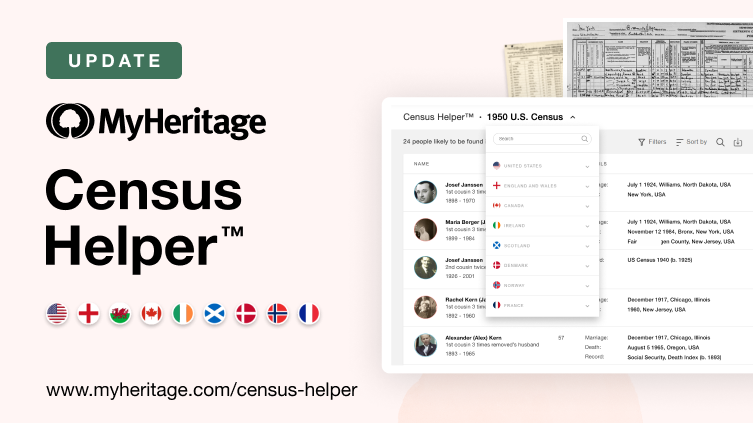
MyHeritage Census Helper™ Gets a Major Upgrade

Just before the release of the 1950 U.S. Census in April 2022, we released the Census Helper™, a tool that scans your family tree and compiles a list of your relatives who are very likely to be found in census records. In the initial release, the Census Helper™ calculated a list of family members to find in the newly released 1950 U.S. census records as well as all available U.S. census collections. Now, we have expanded the Census Helper™ to include census records from other countries, so people with roots in places outside the U.S. can take advantage of it as well — and we’ve added some handy interface improvements that we’ll expand on below.

Use the Census Helper™ now for free

The Census Helper™ is a powerful free tool that offers help with census research and enables you to focus your research. Armed with the list it creates, you’ll know exactly which family members to search for in census records. 

Genealogists were excited to jump-start their research ahead of the 1950 U.S. Census release: for example, Maureen Taylor, the “Photo Detective”, commented on how quickly it helped her. “This is very handy!” she wrote. “I hadn’t gotten around to making a list. The Census Helper™ did it in seconds.” 

With this current update, the Census Helper™ now supports nationwide censuses in the United States, Canada, England and Wales, Scotland, Ireland, France, Denmark, and Norway. 

For example, if you are a MyHeritage user with Danish roots, you’ll be able to use the Census Helper™ to find all the information on your relatives who likely appeared in the 1940 Denmark census — a unique collection exclusive to MyHeritage that isn’t found on other commercial websites. You‘ll also be able to see which people in your family tree might appear in the other nationwide census collections, and then find their records and save them to your tree.

We have also added some sorting and filtering capabilities that will make it even easier for you to make the most of this helpful tool.

If you haven’t yet used the Census Helper™, access the Census Helper™ on your family site under the “Research” tab on the navigation. If you don’t yet have a family tree on MyHeritage, now’s the perfect time to sign up and bring your tree over (via GEDCOM import) and benefit from this useful tool, which will save you time and give direction to your research.

Let’s dive into the update: 

International census records 

We have now added most census records currently available on MyHeritage to the Census Helper™. This includes the United States, England and Wales, Canada, Ireland, Scotland, Denmark, Norway, and France. Smaller-scale census record collections, for example, those that are limited to a specific region, are not featured in the Census Helper™.

By default, when you enter the Census Helper™, it will display the latest census collection that is available for your country of location, if available. 

To pick a different census, use the census selector.
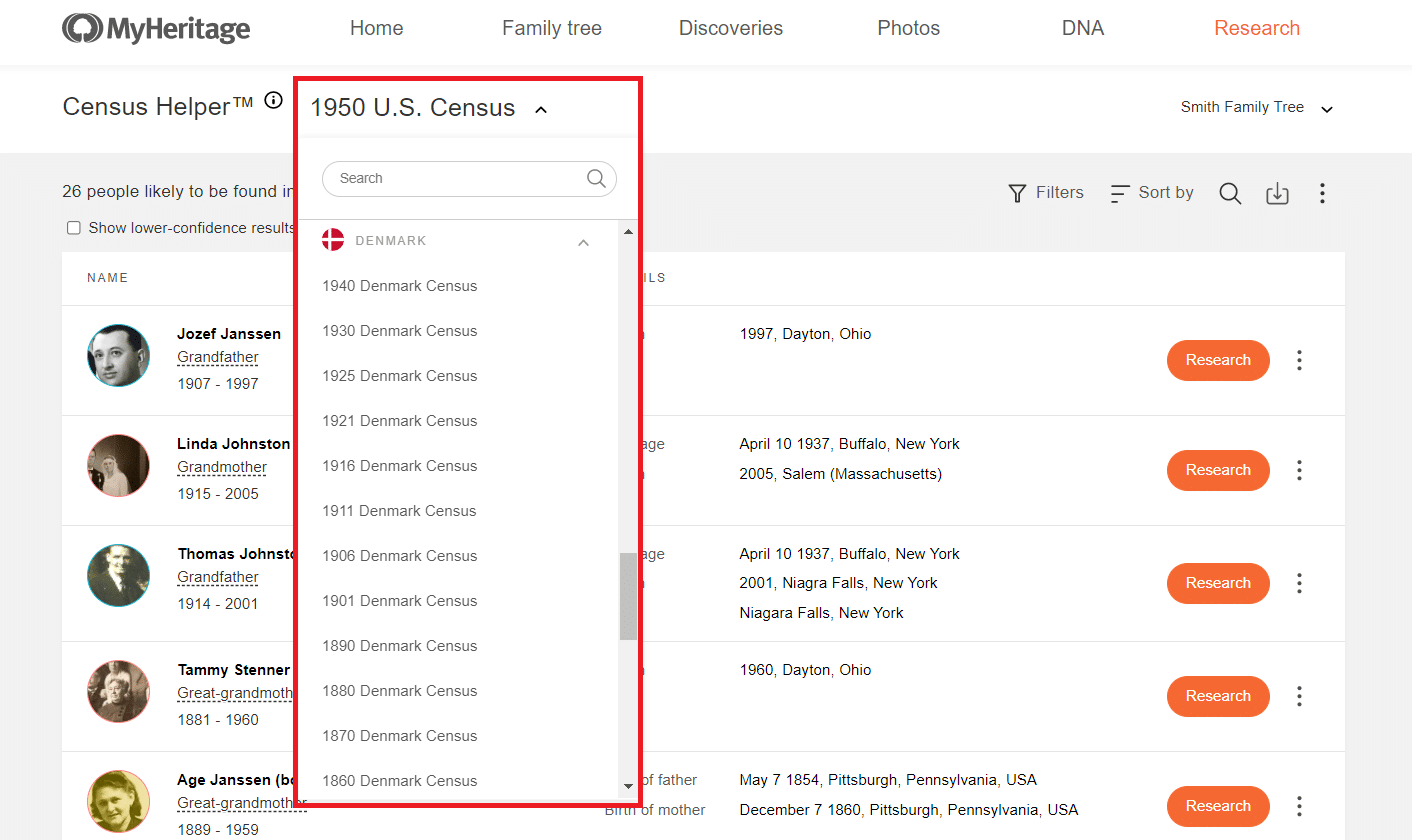
Scroll through the list to view all available census record collections, or enter the name of the collection you’re searching for into the search box. 

Logic and additional cues used by the Census Helper™

When calculating the list of results for the Census Helper™ for European countries, we use a slightly different logic than we do for the U.S. Censuses. 

When calculating people likely to be found in a U.S. Census, we believe it is enough to know that the person lived in the United States at one point in time, either before or after the census in question. This is because it wasn’t very likely for people to leave the United States after living there — although it is entirely possible that they still moved around. We use the same logic for determining whether a person would be found in the Canada, England, or Wales censuses. 

In other European countries, especially during times of political upheaval and war, populations were much less stable. That means that the likelihood that a person located in that specific country before the census was taken would still be there at the time of the census was not as great. For example, if we have evidence that a person lived in Denmark in 1920, we can’t necessarily assume that they would be included in the 1940 Danish Census, as many people emigrated out of Denmark during those years. If we had proof that the individual was in Denmark after the census was taken, however, there is a much greater likelihood that they were there when the census was taken, so they will be included on the Census Helper™ list for that census. 

To determine whether an individual may have been included in a given U.S. census, the initial version of the Census Helper™, searched for evidence that that person was in the United States at the time by analyzing place information entered for life events in the family tree. It also examined Record Matches the individual has to other U.S. collections, such as other U.S. census collections on MyHeritage, or the Social Security Death Index. We have now added which U.S. state the record is from to make it easier for you to search for the individual in the U.S. Census. 

With this update, we have added the capability to determine U.S. residence at the time of the census based on further supporting evidence from Record Matches to the U.S. Public Records Index and the U.S. City Directories on MyHeritage. This new capability might expand your list to include additional people who weren’t there previously. 

In this example, you’ll see that Betty was added to the list of people likely to be found in a particular U.S. Census based on the fact that a Record Match was found for her in the U.S. City Directories: 

User interface changes

Some other capabilities have been added to allow you to easily work through your list of people likely to be found in certain census collections. 

Filters allow you to filter results by the first letter of married or maiden last names. 

Filtering by last names beginning with “S”

Filtering by last names beginning with “S”

The sort option offers the ability to sort by date added to the family tree (the previous default sorting option), your relationship to the individual, their age in the year the census was taken, or by their last name (maiden name for women). 
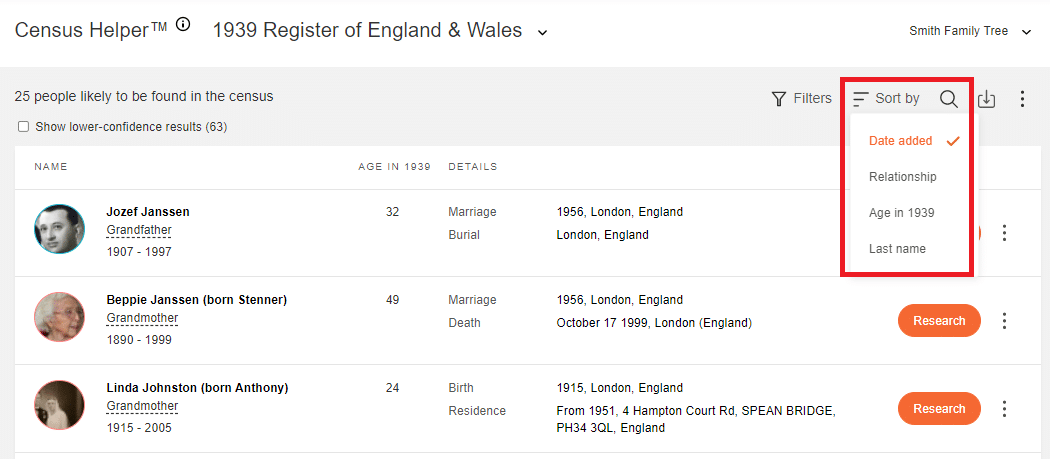
Sorting results in the Census Helper™

Sorting results in the Census Helper™

Use the search bar on the right to locate a specific individual in the results. Type the beginning of the person’s first, middle, or last name and press enter to search. 


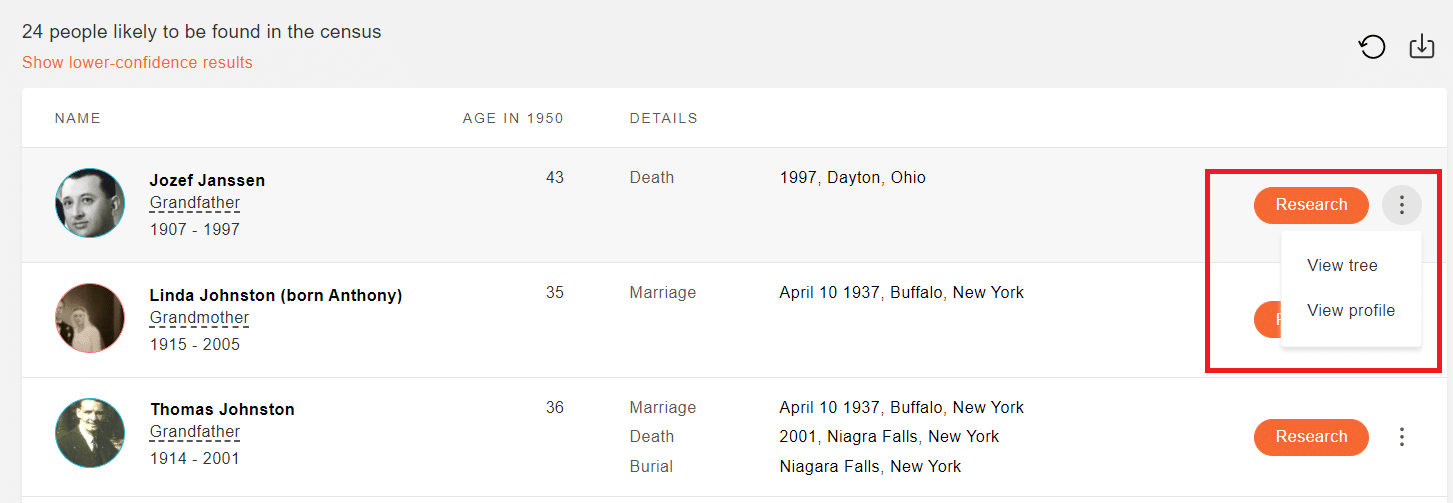
We have also added the option of removing an individual from the list. This is very helpful for keeping an organized workflow. If you are systematically going through the list of individuals that may be in a particular census, you can remove those that you have determined are not in the census, and concentrate on your current up-to-date list. 

Right-click on the three dots next to a name to remove them from the list. 
Summary

The Census Helper™ continues to be a useful tool that helps genealogists save time while searching for their ancestors in census records — now from across the globe and not just the United States. We’ve improved the reports that it generates, and made it easier to use. We continue to offer it completely free of charge to MyHeritage users and non-users alike, and we warmly invite you to give it a try and see what new information you uncover about your family in census records from across the world!

Thursday, March 31, 2022

MyHeritage Introduces Census Helper™


MyHeritage has just released a free tool called The Census Helper™, a great facility that scans your tree and automatically compiles a list of individuals appearing in it who are very likely to be found in the 1950 U.S. census, along with relevant details. Armed with this list, you’ll know exactly which family members to search for in the newly released records, and your research will be much more focused. You’ll also be able to research those individuals in the census records with the click of a button.


It also provides the facility to produce a list of people in your tree who are likely to be included in every other census, from 1790 through 1940.


I encourage that if you don't have a tree on MyHeritage to upload it as a GEDCOM and use this tool for free, so they can get a head start on your 1950 census research. You can do so via this landing page.

Census Helper feature 753x423 blog image

You can learn more about the Census Helper™ in the MyHeritage blog post, and feel free to spread the word.


    Sunday, February 27, 2022

    All About the 1950 U.S. Census from the National Archives and Records Administration


    Genealogists have been waiting for the release of the 1950 U.S. Federal Census and, after 72 years, the wait will end on 1 April 2022 when the National Archives and Records Administration (NARA) opens the records to the public. 

    The Genealogy Guys Podcast, episode #402 (http://genealogyguys.com/the-genealogy-guys-podcast-402), includes a detailed discussion of what's coming and when. Of particular importance is that an every-name index has been created using Artificial Intelligence (AI) and it will be available on Day One.

    Here are two important NARA resource links to help you learn more:
    In addition, NARA will be presenting free webinars on the subject beginning on 2 March 2022. See the schedule at https://www.archives.gov/calendar/genealogy-series/2022

    Listen to the Genealogy Guys Podcasts for ongoing coverage of what's happening with the 1950 Census at NARA and at the commercial online genealogical sites.

    Thursday, April 1, 2021

    The 1950 Census is coming in 2022!


    Preparing for the 1950 Census

    The next Decennial (ten-year) Census of the United States will be available online next year. In 1978, Public Law 95-416, also known as the “72-Year Rule,” restricted access to decennial records to everyone except for the individual named on the record for 72 years. The National Archives will release the 1950 Census records in April 2022.

    The 1950 Census contains an estimated:

    • 7,816,000 population schedule pages
    • 9,634 enumeration district maps
    • 60,000 “Indian Census” pages

    The agency has been preparing for this launch for the last decade. Right after we launched the 1940 website in 2012, we developed a list of lessons learned, and began planning for the scanning of the 1950 Census.  It is a good thing we started early, too, because we have had limited access to our buildings during the pandemic. Fortunately, selected staff who have received special clearances to work on these records have scanned the majority of the pages and are also able to work remotely on indexing efforts. Our staff are busy ensuring that state, county, city and enumeration district metadata will be available at the time of launch. 

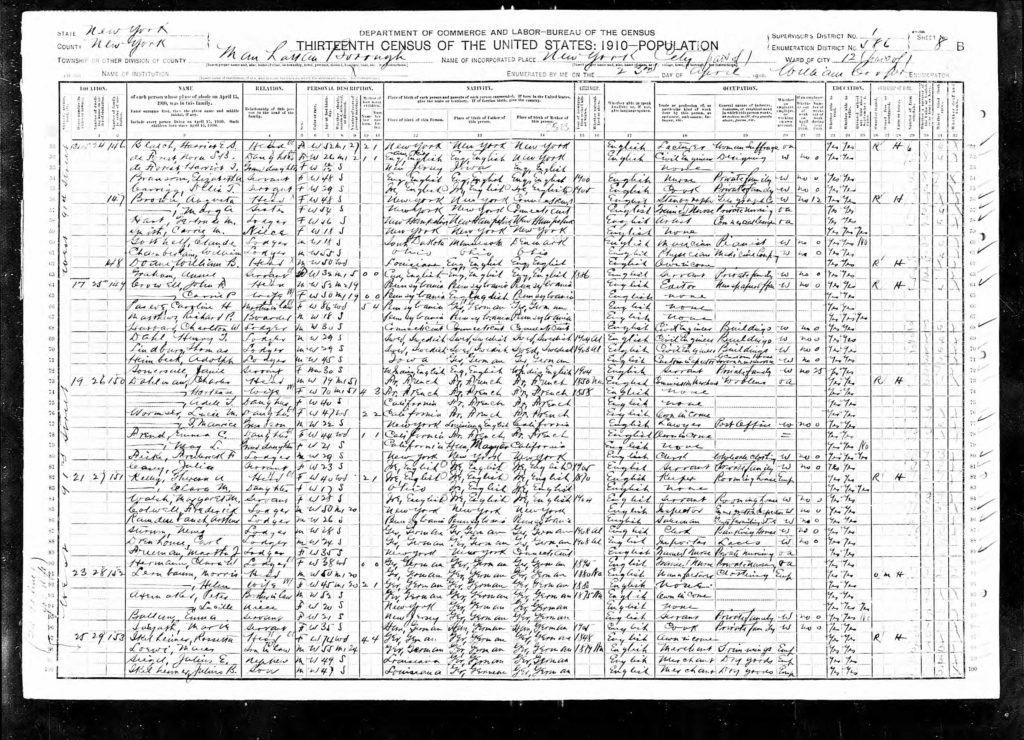
    Population schedule page from the 13th Census of the United States: 1910, National Archives Identifier 53333251.

    Our User Experience team has been working with a variety of NARA staff and public stakeholders to develop the website. Using agile and human-centered design methodologies, we have recently completed our first sprints working with wireframes to develop what will be the layout of the webpage. We are planning to use current cloud technologies to ensure that the website will be able to withstand the expected crush of users when we launch in April 2022 and beyond. We are also exploring ways to provide person names, which we know are the most common searches for family historians and researchers. 

    In addition to the website, we are exploring possibilities for providing bulk downloads of the 1950 Census for those who would like to work with the data as a whole or in large chunks, for digital humanities and other purposes beyond the traditional genealogical value that the Census holds. 

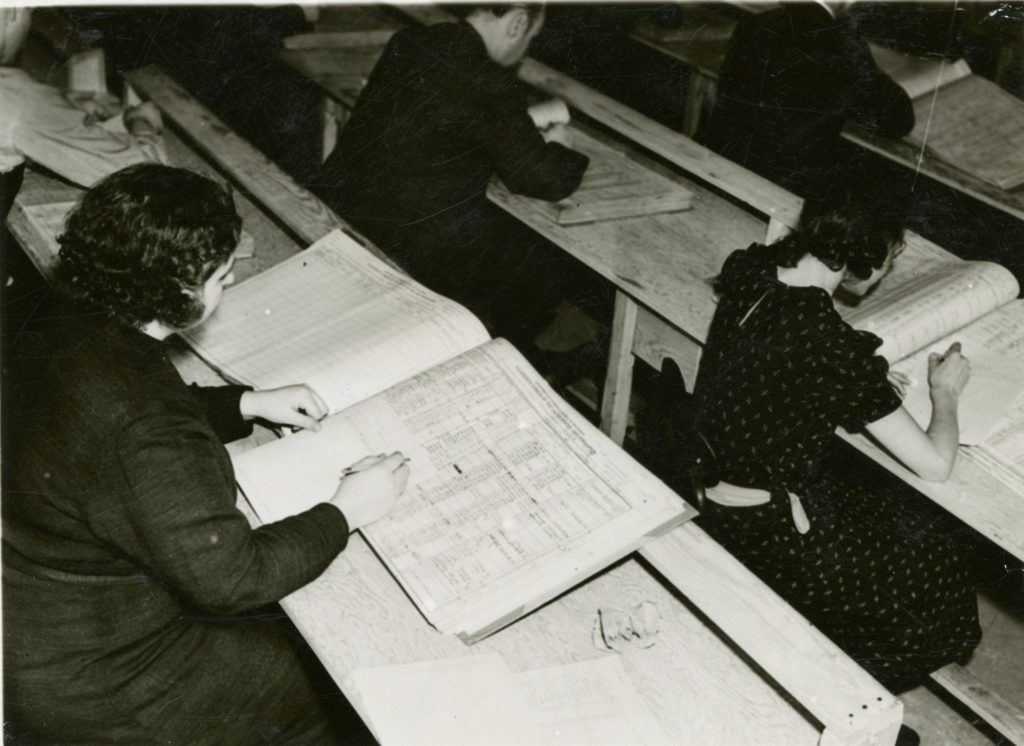
    WPA Workers Indexing 1920 Census Records, National Archives Identifier 175739355

    We know that the Census data is important to so many of you. Supporting public access to these records is right at the heart of our mission–to make access happen. We have much to do, many constraints, and relatively little time left to accomplish our vision.  Stay tuned for upcoming developments as we work toward our April 2022 launch. 

    For more information about Census records at the National Archives, see our Census Records web pages. See also the Census Bureau’s overview of the 1950 Census.


    Friday, April 19, 2019

    Using Vivid-Pix to Improve Document Legibility

    We should all be grateful to the National Archives and Records Administration (NARA) for its efforts to microfilm all of the available US federal census documents from1790 to 1940. Over the years, the microfilm images have been digitized, indexed, and placed online, particularly by FamilySearch.org, Ancestry.com, MyHeritage.com, Findmypast.com, and others. These records are the basic essential tools for locating and documenting our American ancestors.

    Unfortunately, the quality of the microfilm images are not always great. Lighting problems made portions of a document unreadable, while light handwriting or faded ink make all or part of a document illegible. The entities who digitized the microfilm also uses high-speed scanners and software which could not correct or improve the microfilm images. In some cases, the resulting digital image was worse than the microfilmed image.

    I've been using the Vivid-Pix RESTORE software for several months with a great deal of success. Not only have I made old photos better, I've also used the software on digital images of documents and newspaper content to make them more readable.

    Here is an example of an 1880 US federal census agricultural census schedule containing information about my great-grandfather's farm. The image below was downloaded from one of the providers.

    Digitized image of microfilmed1880 US federal census agricultural schedule.
    (Click to enlarge.)

    The image below was made better by using Vivid-Pix RESTORE and adjusting the lightness and contrast until more of the image could be read.

    Improved digital image of microfilmed 1880 US federal census agricultural schedule
    after using Vivid-Pix RESTORE.
    (Click to enlarge.)

    You can enjoy a free trial as a perk of our sponsor, Vivid-Pix. Visit https://vivid-pix.com/RESTORE?pop_code=3GenealogyGuys and click on the Free Trial button for the Windows or Mac version of the software. Download your free trial copy. Try it on your most faded photographs, the most difficult documents, on newspaper clippings, and on downloaded images. Enjoy the free trial on us!


    Saturday, July 28, 2018

    What is already known (or believed to be known)

    When we start out researching a particular brick wall genealogical question, it is probably a good idea to re-confirm some of the information that leads us to the brick wall.

    If my goal is to discover the name of the mother of my great-grandmother, Elizabeth "Bettie" Foshee King, then a good starting place is to first identify everything that I might already know (or think that I know) about Elizabeth herself.  So let's explore that:

    The Application for Social Security Account Number (the SS-5) for my maternal grandmother, Elizabeth "Lizzie" King Martin, identifies her parents as Robert King and Elizabeth Foshee.

    The Laurens City Cemetery in Laurens, South Carolina, has a stone for Elizabeth Foshee King (identified there as Bettie King, born 1845 and died 1929). An image of the stone appears on Find A Grave. Her stone is next to that of her husband, listed on his stone as R. B. King.

    The Spartanburg [S.C.] Herald has an obituary in its December 2, 1928 issue for Mrs. R. B. King, indicating that she was 84 at the time of her death on November 30. This conflicts with the death year on the stone (but the stone might have been placed in early 1929). Based on her age in the obituary, her birth year would be as early as 1844, or even 1843 if she was born after November 30 of that year.

    The South Carolina Department of Archives & History has an index entry indicating that Bettie King of Laurens applied for a pension based on Robert B. King's military service in the Civil War. The actual application indicates that Elizabeth was born August 6, 1844, and married her husband on January 27, 1869.

    Before we start looking for Elizabeth Foshee before she married Robert B. King, let's look at her in census records with Robert, starting with 1920 and going backwards to 1870.

    In 1920, 75-year-old widow Betty King is living in Laurens with her daughter Sue Rickman and son-in-law Fred Rickman. (I personally remember Great-Aunt Sue Rickman quite well.)

    In 1910, 64-year-old Lizzie King is living in Laurens with her husband Robert (as well as with the Rickmans).

    In 1900, 52-year-old Mrs. S. A. [?] King is living in Laurens with her husband Robert, as well as children Walter B., Lizzie (my grandmother), and Sussie.

    In 1880, 26-year-old Bettie King is living in Laurens with her husband Robbert and their 7 oldest children.

    In 1870, we hit a snag. No evidence of Robert and Bettie in Laurens. The plot thickens...