HAPPY NEW YEAR! We've just uploaded a new video lesson to Genealogy Guys Learn. This one is "Using FamilySearch.org to Find Genealogical Records", presented by Drew Smith. Learn how to navigate and get the most out of your research at FamilySearch.
Monday, January 2, 2023


Sunday, January 1, 2023
2023: The Year of the Research Trip to Ireland
When I decided to retire from my full-time job as a librarian at the University of South Florida Libraries, I set a date for early August 2023. This meant that I would have more flexibility with my time after that. So when I then heard that Irish genealogy expert Donna Moughty, who I have known for many years, was planning to conduct her last research trip to Dublin in October 2023, I immediately seized on the idea of being part of it, together with my brother Jeff. Neither of us had ever been to Ireland, and as all of my Grandfather Smith's ancestors were from Ireland, I wanted the opportunity for us s to learn more about them.

Photo: Abbeyleix Heritage House, which I plan to visit when I'm there
Both of Grandfather Smith's parents had 100% Irish ancestry, with the Smiths and Reillys from County Cavan and the Bannons and Hylands from County Laois. I decided to focus on the latter families, partly because I knew exactly where in County Laois they were from (not so with the Reillys in County Cavan) and because the surnames were somewhat more unusual (certainly less common than Smith and Reilly!).
So this meant that my research would be primarily about the ancestors of my great-grandmother Mary Ann Bannon, who married my great-grandfather, Charles Henry Smith. You may have heard me speak or write about Mary Ann Smith before, but that was almost always Mary Ann Reilly Smith, Charles' mother. What I knew about Mary Ann Bannon was that she and my great-grandfather were buried in the same plot as Mary Ann Reilly Smith, as were my grandfather William Henry Smith and one of his brothers.
Also, Mary Ann Bannon was born in England, as was her brother James Joseph Bannon. But after the birth of James Joseph, the family left England for Newark, New Jersey, between 1867 and 1872, and had one more child, Catherine R. "Kate" Bannon. A few years ago, I realized that Kate had married Patrick J. O'Connor and was buried in the same cemetery, Holy Sepulchre, as Mary Ann Bannon, but in a different plot with James Joseph Bannon. And who else was buried with them? Their parents, William Bannon and Mary Ann Hyland.
I have much more to say about Mary Ann Bannon and her ancestors and their descendants, some of whom also came to Newark but others who remained in England. And I have a lot more work to do on the Bannons and Hylands before they left County Laois for England.
From now through the rest of 2023, I plan to post weekly updates on the preparations for the research trip and what I am learning as I go. I hope you will enjoy it.
Photo: Abbeyleix Heritage House, which I plan to visit when I'm there
Saturday, December 31, 2022
Happy New Year 2023!

George and Drew, the Genealogy Guys, would like to wish all our friends, family, and every genealogist a wonderful new year filled with great research successes!
Thursday, December 29, 2022
MyHeritage Announces New Global Name Translation™ for DNA Matches
Just Received from MyHeritage

MyHeritage has long made a name for itself as the go-to destination for international genealogy. This strength comes from the fact that MyHeritage is translated into 42 languages, and is the most popular genealogy platform in most non-English speaking countries, in addition to its widespread popularity in the English-speaking world. Users around the world have built millions of family trees on MyHeritage, and when combined with diverse historical record collections and unique technology for overcoming language barriers, it’s clear why MyHeritage is the leading family history service in Europe and many other countries.
Our commitment to innovation means that we’re constantly adding new technologies, while improving those that are already on MyHeritage even further. Today, we’re delighted to announce that we’ve taken our Global Name Translation Technology™ to the next level, and applied it to DNA Matches!
Language can often serve as an obstacle when exploring your origins in a different country. Back in 2015, MyHeritage pioneered Global Name Translation™, a unique technology to help users overcome language barriers as they conduct their family history research. Global Name Translation™ automatically translates names in family trees and historical records from one language to another, enabling users to connect with relatives and locate historical records in different and sometimes unexpected languages. We first applied this technology to search results in our historical record search engine and integrated it into our matching technologies for new information added to family trees. In 2020, we extended Global Name Translation™ to enable cross-language Record Matches.
This newest application of Global Name Translation™ is great news for users who receive DNA Matches in Greek, Hebrew, Ukrainian, and Russian, or whose display language on MyHeritage is one of those languages. Both will now find the names of their DNA Matches transliterated, either from non-Latin characters to Latin letters (English), or from Latin letters to the selected language on their family site.
How it works
Global Name Translation™ uses advanced algorithms that were developed based on MyHeritage’s vast international database of 18.8 billion historical records. The technology automatically translates names found in family trees, historical records, and now, DNA Matches, with very high accuracy and generates all plausible versions of the name to facilitate matches in different languages. English serves as the common ground behind the scenes. Without modifying data that is entered into MyHeritage and stored in its original language, this technology matches similar names written in different languages with each other. It also utilizes extensive dictionaries built by MyHeritage to cover synonyms and nicknames.
Let’s say you’re a Greek MyHeritage user who isn’t aware of any family connections in Israel. Suddenly, a DNA Match tells you otherwise, but you can’t read the name of the match because it’s in Hebrew. Until now, not knowing a person’s name or how to address them may have even prevented some users from contacting their matches in the first place. Thanks to this new extension of Global Name Translation™, you’ll be able to read the name of your DNA Match from Israel and contact them using their given name.
Accessing DNA Matches
To view DNA Matches for any DNA kit that you manage, hover over the DNA tab on the navigation bar and select “DNA Matches”.

Accessing DNA Matches (click to zoom)
As you scroll through your DNA Matches, you’ll notice that for names of matches written in non-Latin letters, a set of square brackets with the transliterated name now appears directly after the original name. In the example below, the name of the match is originally written in Ukrainian, and an English transliteration appears in the brackets that follow. Further down the card, the link to contact this match also shows the transliterated name, making it easier for users to contact DNA Matches whose names they would not otherwise have known due the language barrier.
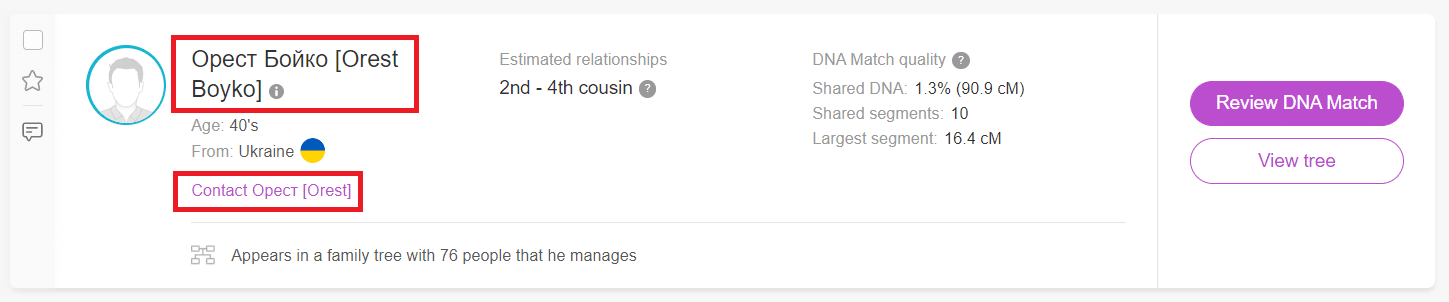
Example of a Ukrainian name transliterated to English (click to zoom)
For users whose MyHeritage site language is set to Hebrew or Greek, DNA Match names that are in English will likewise appear in brackets in the user’s language. In the example below, Jacob Glick’s name appears in English, with the Hebrew transliteration directly next to it.

Example of an English name transliterated to Hebrew (click to zoom)
The same is true for users who work with MyHeritage in Russian or Ukrainian and receive DNA Matches to individuals with names that use the Latin alphabet. In the example below, the MyHeritage site language is Ukrainian, and the name of the DNA Match, Larry Movchan, appears in English with the Ukrainian transliteration displayed in brackets.
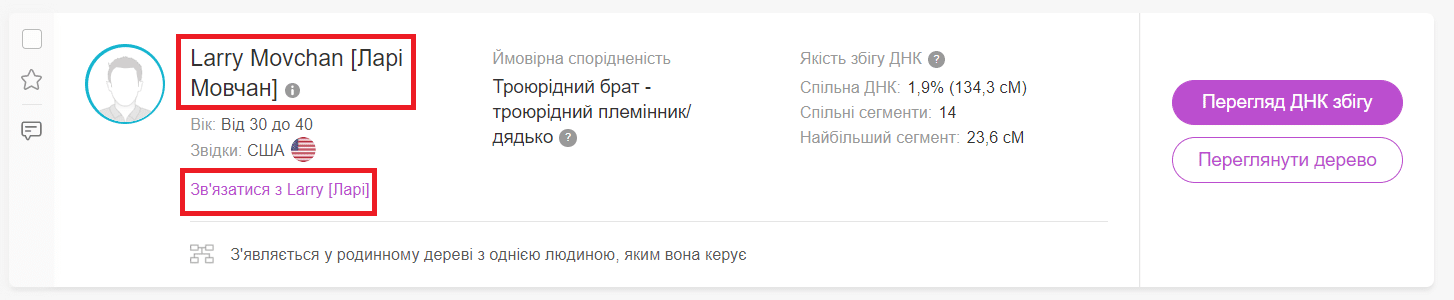
Example of an English name transliterated to Ukrainian (click to zoom)
For users whose DNA kit is managed by someone other than themselves, the transliteration of the kit manager’s name will appear in brackets alongside the names in their language. If the match in question appears in a family tree that is managed by another MyHeritage user, the tree manager’s name is also transliterated.
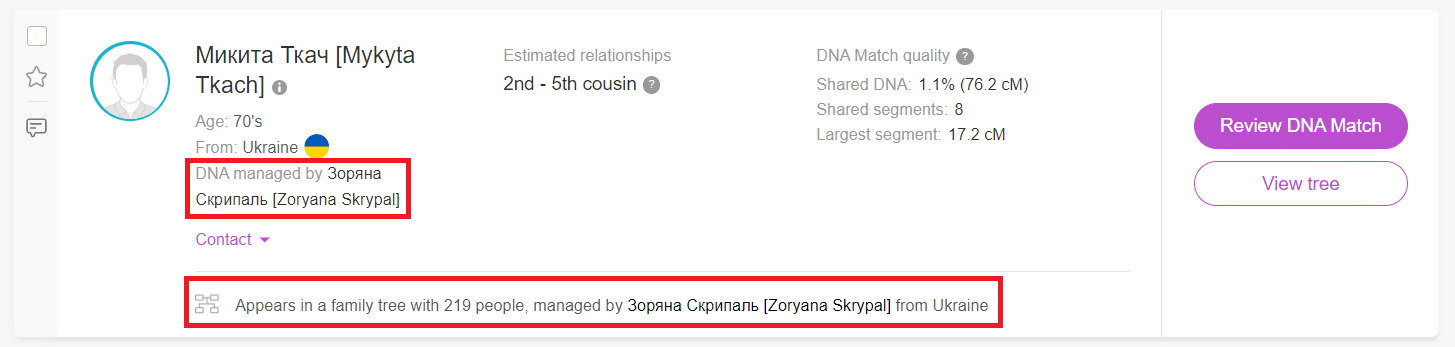
Transliterations appear for names of DNA kit managers (click to zoom)
When clicking on the “Contact” drop down below the name of the DNA kit manager, the names of both the DNA Match and the kit manager also include transliterations.

Transliteration of DNA Match and kit manager’s names
Transliterated names are also displayed on the Review DNA Match page.
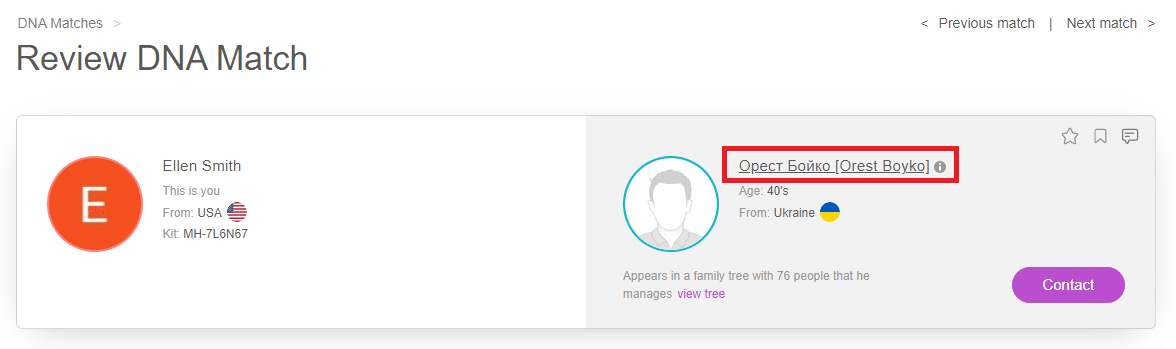
Name transliteration on the Review DNA Match page
This functionality is currently not available when reviewing Shared DNA Matches, and we plan to add it in the near future. It’s also important to note that DNA Matches who have set their names to private will not have their names transliterated.
Our DNA Matching algorithms automatically calculate new matches for you, and MyHeritage DNA users receive weekly emails notifying them when we’ve found new DNA Matches. Transliterated names are now displayed in those emails, making it easier to understand the match at a glance and see if perhaps you share a common surname, or if something about their name sparks your curiosity.
Conclusion
Global Name Translation™ is a powerful technology that has opened new frontiers for MyHeritage users researching their family history around the world. This technology is unique to MyHeritage, and we hope this new extension of it will facilitate more communication among DNA Matches. Anyone who has DNA results on MyHeritage can now view the transliterated names of their DNA Matches.
Language is one obstacle that shouldn’t hinder family history research. We are proud to continue our tradition of innovation as our technologies help overcome language barriers and foster a more seamless path to discovery.
Wednesday, December 21, 2022
Gifts that Help Alzheimer's Families Capture Memories from Vivid-Vix
Gifts that Help Alzheimer's Families Capture Memories
Research-based Software and Education that Create Neurogenesis

CHARLESTON, SOUTH CAROLINA, USA, December 15, 2022 /EINPresswire.com/ -- Photo software company Vivid-Pix is helping millions of families use Photo Reminiscence Therapy and software solutions to connect with their loved ones with cognitive decline this holiday season.
Over 8.8 million Americans are currently living with Alzheimer’s and other forms of dementia. Their families strive to spend time with them and include them in activities during the holidays. Vivid-Pix worked with experts to create education and solutions to capture their memories, creating multi-generational conversation, and have included gift ideas with this philosophy in mind in their first annual holiday gift guide.
Vivid-Pix participated in proprietary research with the National Institute for Dementia Education (NIDE) that concluded that Photo Reminiscence Therapy (pRT) can minimize social isolation, improve medication compliance, and general cognitive performance. The complete pRT study is available at: https://nid.education/nide-publications.html. Videos about the study are available at: https://www.vivid-pix.com/reminisce/.

About Vivid-Pix
Vivid-Pix helps people relive photos and documents by connecting individuals, families, and friends with their most treasured memories, restored through Vivid-Pix technology. The U.S. Patent Office has awarded two patents to Vivid-Pix for its image processing techniques used to automatically correct faded images. Vivid-Pix founders brought Kodak’s “You Press the Button, We Do the Rest” philosophy to the design of Vivid-Pix RESTORE software and other Vivid-Pix solutions.
Media contact:
Name: Rick Voight
Phone: 404-664-9897
Email: Rick.Voight@Vivid-Pix.com
Website: www.vivid-pix.com

https://www.vivid-pix.com/
Sunday, December 18, 2022
Happy Holidays!
The Genealogy Guys wish you, your family, and your loved ones a fabulous Christmas and a wonderful New Year!


Subscribe to:
Posts (Atom)