Wednesday, May 26, 2021

Introducing Photo Repair on MyHeritage - New Feature to Automatically Fix Scratched and Damaged Photos


MyHeritage did it again! I’m very excited to announce the release of Photo Repair — the newest feature to join MyHeritage’s photo toolbox. Photo Repair automagically fixes scratches, tears, holes, stains and other damage on historical photos.


When a photo is uploaded to MyHeritage, a specialized detection algorithm runs in the background and determines if it has sustained damage. If so, a Repair button will appear, ensuring that users will not waste time attempting to repair photos that don’t need it. Photos may be repaired with a single click, and in just a few seconds. The default repair model, named Gentle Repair, will fix most types of damage with minimal changes to the rest of the photo. For photos with more substantial damage, an Extensive Repair model can be applied.

Watch the video to see some amazing examples of the results produced when using Photo Repair. 

Please see some more incredible examples of repaired photos in the blog post and find more information in the press release. See for yourself!


Enjoy!

Daniel Horowitz

Genealogy Expert

Wednesday, May 19, 2021

MyHeritage Announces New Filtering of DNA Matches by Genetic Groups


Greetings!

I’m happy to share that we’ve added a new filtering option on the DNA Matches page, which enables users to filter their DNA Matches to show only those who are members of a certain Genetic Group.

By filtering your matches based on a Genetic Group, you’ll be able to further pinpoint which matches come from a specific location or region, giving you deeper insight into how you’re related. You can filter the matches based on the Genetic Groups in your results, or use the search field to search for any of the 2,114 Genetic Groups supported on MyHeritage.


Enjoy! 


Daniel Horowitz

Genealogy Expert

MyHeritage Ltd., P.O.Box 50, 3 Ariel Sharon Blvd., Or Yehuda, Israel 6037606, Israel, +972-3-6280000


Thursday, April 29, 2021

Findmypast Announces Weekend of Free Access to all British Census Records

cid:image001.png@01D72CB2.FBDD8AC0

Findmypast announces weekend of free access to all British census records

·         All British census records from 1841 to 1911 free to access from April 30th to May 3rd

·         Includes free access to census hints on family trees and Findmypast’s new address search

·         Explore the lives of your ancestors, the history of your home or grow your family tree


Leading family history website Findmypast have announced a weekend of free access to their collection of British census records.


From 10 am(BST) on Friday April 30th to Monday May 3rd, all British censuses from 1841 to 1911 will be completely free to search and explore.


Census records are the perfect way to tell the story of what your family looked like in times gone by. They not only reveal where your ancestors lived what they were doing, but can also provide valuable clues as to where they may be found in other family records.


By offering free access to these essential resources, Findmypast is providing all visitors to the site with the opportunity to discover a whole host a valuable family details, jump back through the generations and grow their family tree.


Those looking to explore the history of their home or local area can make use of Findmypast’s recently released address search feature. Unique to Findmypast, this new tool makes it easier to search for streets and locations across all UK censuses to trace the occupancy of a specific address, locate ancestors or discover their friends, relatives and neighbors.


Any user who creates or uploads a family tree for free on Findmypast can also take full advantage of any tree hints generated by census records.


All visitors are required to register an account before searching for free. Visit https://www.findmypast.com/page/free-access for more information.

Monday, April 5, 2021

MyHeritage Releases 10 "Special Animations" for Deep Nostalgia

We've released 10 additional "special" animations for Deep Nostalgia™ today, doubling the number of animations available and allowing you to see your ancestors express a wider spectrum of gestures and emotions, for example, dance, blow a kiss, smile wholeheartedly, nod approval, and more. The special animations are available to subscribers on the Complete plan.

Deep-Nostalgia-Featured-Image_D_04_blog_image

Deep Nostalgia™ has taken social media by storm, and since its launch 5 weeks ago, 72 million animations have been created!


Please share this wonderful news with your audience and on all your social channels. You can find a complete overview of the special animations in the blog post.


Here are some examples of the special animations:

Dance 2:

ezgif.com-gif-maker

Kiss:

Kissopt

When you animate a photo, the initial animation is selected by default so as to match the pose and angle of the person in your photo perfectly. That initial animation is always one of the first 10 general animations and is never one of the special animations. The special animations need to be selected manually.


Selecting a special animation is not available from the landing page, which is only meant for quick animation and sharing, and is only available from the "My Photos" section of the website and the "Photos" section of the MyHeritage mobile app, where in both locations more advanced functionality is at your disposal.


I hope you enjoy seeing your ancestors move with these new animations!


Enjoy! 

Daniel Horowitz

Genealogy Expert

Thursday, April 1, 2021

The 1950 Census is coming in 2022!


Preparing for the 1950 Census

The next Decennial (ten-year) Census of the United States will be available online next year. In 1978, Public Law 95-416, also known as the “72-Year Rule,” restricted access to decennial records to everyone except for the individual named on the record for 72 years. The National Archives will release the 1950 Census records in April 2022.

The 1950 Census contains an estimated:

  • 7,816,000 population schedule pages
  • 9,634 enumeration district maps
  • 60,000 “Indian Census” pages

The agency has been preparing for this launch for the last decade. Right after we launched the 1940 website in 2012, we developed a list of lessons learned, and began planning for the scanning of the 1950 Census.  It is a good thing we started early, too, because we have had limited access to our buildings during the pandemic. Fortunately, selected staff who have received special clearances to work on these records have scanned the majority of the pages and are also able to work remotely on indexing efforts. Our staff are busy ensuring that state, county, city and enumeration district metadata will be available at the time of launch. 

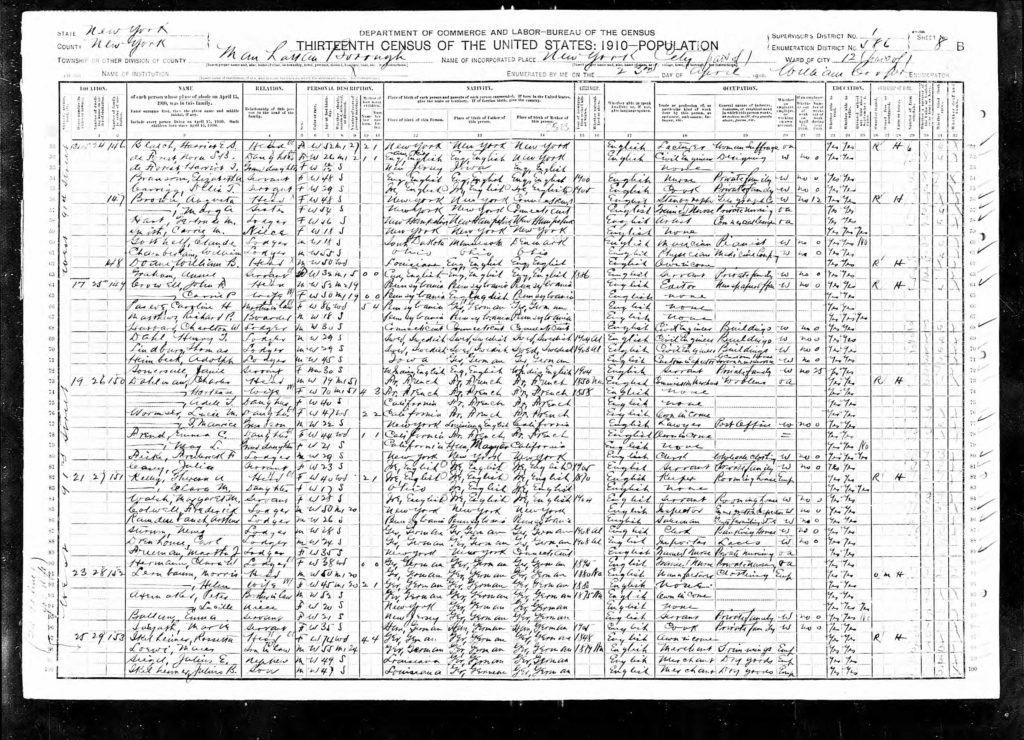
Population schedule page from the 13th Census of the United States: 1910, National Archives Identifier 53333251.

Our User Experience team has been working with a variety of NARA staff and public stakeholders to develop the website. Using agile and human-centered design methodologies, we have recently completed our first sprints working with wireframes to develop what will be the layout of the webpage. We are planning to use current cloud technologies to ensure that the website will be able to withstand the expected crush of users when we launch in April 2022 and beyond. We are also exploring ways to provide person names, which we know are the most common searches for family historians and researchers. 

In addition to the website, we are exploring possibilities for providing bulk downloads of the 1950 Census for those who would like to work with the data as a whole or in large chunks, for digital humanities and other purposes beyond the traditional genealogical value that the Census holds. 

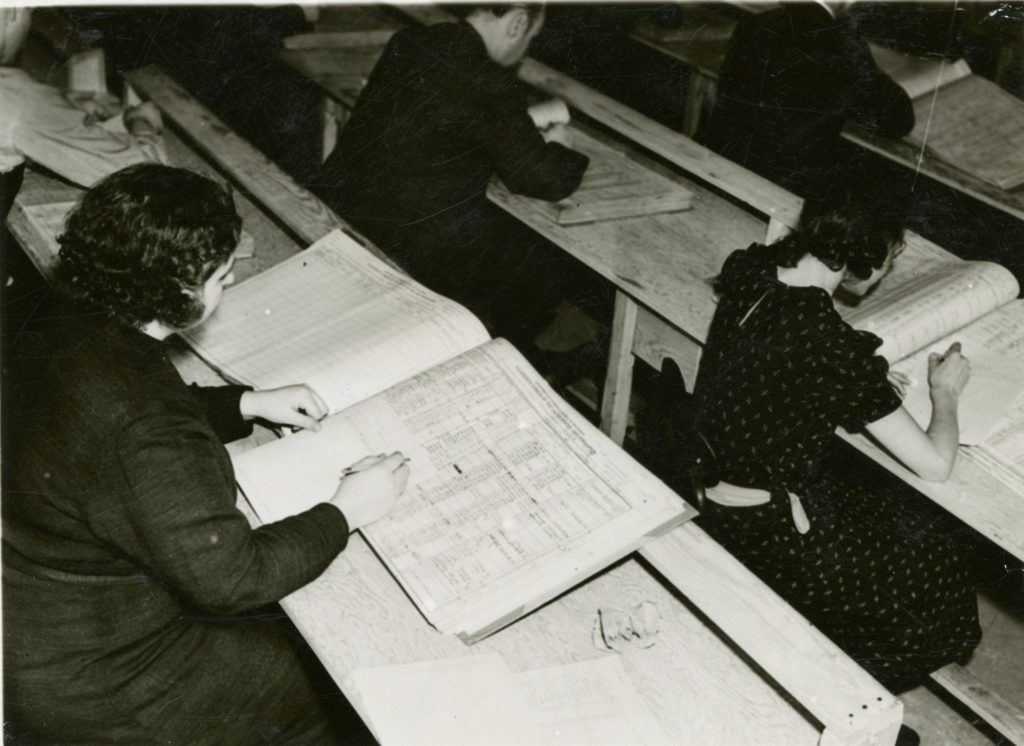
WPA Workers Indexing 1920 Census Records, National Archives Identifier 175739355

We know that the Census data is important to so many of you. Supporting public access to these records is right at the heart of our mission–to make access happen. We have much to do, many constraints, and relatively little time left to accomplish our vision.  Stay tuned for upcoming developments as we work toward our April 2022 launch. 

For more information about Census records at the National Archives, see our Census Records web pages. See also the Census Bureau’s overview of the 1950 Census.


Wednesday, March 31, 2021

MyHeritage Announces View Genetic Groups and Updated Swedish Household Records

Viewing Genetic Groups of DNA Matches

As part of our continued improvement of Genetic Groups on MyHeritage, you can now compare your Genetic Groups to those of your DNA Matches! Previously, you were able to view the Ethnicity Estimate of your DNA Matches and see which ethnicities you share. Now, you can drill down even further and see which Genetic Groups they belong to, and which ones you have in common. This addition has important genealogical value, and may enable you to narrow down which side of your family a DNA Match comes from. Read more about this exciting new addition in the blog post.  

View_the_Genetic_Groups_of_Your_DNA_Matches

Significant Update to Swedish Historical Records on MyHeritage

We recently added 19.35 million records to our collection of Sweden Household Examination Books. The new records cover the years 1820–1839, and bring the total number of records in this collection to 144.5 million. The records in this collection are the #1 source of information about families and individuals who lived in Sweden in the 19th and 20th centuries. This is great news for all genealogists with Swedish roots, who may now be able to date their family tree back even further and make new discoveries.

Sweden-Household-Examination-Records-Update

You can search the collection now, and read more about it on our blog

My March through the FamilySearch Family Tree: Day 31 (what's next?)

The month flew by, but I feel that I ended it with a much stronger family tree on FamilySearch Family Tree, especially my paternal side, but also my maternal-side ancestors. There are still things to do, but I think that I learned enough that the month-long experiment was worth doing.

I encourage anyone who has never used the FamilySearch Family Tree to explore it. And I encourage those who have tried it in the past but who were disappointed with all the problems to look at it again, and consider doing it, at least in part.

There are other collaborative trees out there. WikiTree is one, and I will be expecting to write about my experiences there sometime in August. Between now and then, I may take a closer look at Geni. There are other sites, too, but one can only spend so much time with these things. I also will continue to work on my "official" tree on my own computer, and I will upload copies to public sites (Ancestry, MyHeritage, etc.).

I am hopeful that my actions will result in collaborations with previously unknown cousins. Part of the fun of doing genealogy is doing it with others. Imagine working with a distant cousin to attempt to break down a brick wall involving common ancestors!

I would love to hear about your own experiences in using FamilySearch Family Tree, especially successes. I want to hear about any tricks you have learned. I posted links to this entire series on Facebook in The Genealogy Squad group, and that is a great place to engage with other genealogists, including me!

I am also going to talk to the folks at FamilySearch who are the official Family Tree managers. I can give them the benefit of my own experience and perhaps suggest ways to improve it.

I hope you enjoyed my "march" in March. If there are other sites or tools you'd like me to spend a month exploring, let me know.