JUST ANNOUNCED BY MyHeritage
The following was just announced by MyHeritage:
JUST ANNOUNCED BY MyHeritage
The following was just announced by MyHeritage:
Starting today, 18 November 2024, MyHeritage DNA is available at a great price at https://www.myheritage.com/
-1.jpg?width=1200&upscale=true&name=US_Pre-Black-Friday-sale_version23_1200x800%20(1)-1.jpg) |
This is a great chance for anyone ready to start their family history journey or get a unique holiday gift taken care of early.
Visit the link at https://www.myheritage.com/order/3146053474/MhDna.LandingPage?initialProductId=900&processor=adyen&thirdPartyPaymentProcessor=adyen to place your order today!
Daniel Horowitz

Daniel Horowitz
Just Received from MyHeritage

MyHeritage has long made a name for itself as the go-to destination for international genealogy. This strength comes from the fact that MyHeritage is translated into 42 languages, and is the most popular genealogy platform in most non-English speaking countries, in addition to its widespread popularity in the English-speaking world. Users around the world have built millions of family trees on MyHeritage, and when combined with diverse historical record collections and unique technology for overcoming language barriers, it’s clear why MyHeritage is the leading family history service in Europe and many other countries.
Our commitment to innovation means that we’re constantly adding new technologies, while improving those that are already on MyHeritage even further. Today, we’re delighted to announce that we’ve taken our Global Name Translation Technology™ to the next level, and applied it to DNA Matches!
Language can often serve as an obstacle when exploring your origins in a different country. Back in 2015, MyHeritage pioneered Global Name Translation™, a unique technology to help users overcome language barriers as they conduct their family history research. Global Name Translation™ automatically translates names in family trees and historical records from one language to another, enabling users to connect with relatives and locate historical records in different and sometimes unexpected languages. We first applied this technology to search results in our historical record search engine and integrated it into our matching technologies for new information added to family trees. In 2020, we extended Global Name Translation™ to enable cross-language Record Matches.
This newest application of Global Name Translation™ is great news for users who receive DNA Matches in Greek, Hebrew, Ukrainian, and Russian, or whose display language on MyHeritage is one of those languages. Both will now find the names of their DNA Matches transliterated, either from non-Latin characters to Latin letters (English), or from Latin letters to the selected language on their family site.
Global Name Translation™ uses advanced algorithms that were developed based on MyHeritage’s vast international database of 18.8 billion historical records. The technology automatically translates names found in family trees, historical records, and now, DNA Matches, with very high accuracy and generates all plausible versions of the name to facilitate matches in different languages. English serves as the common ground behind the scenes. Without modifying data that is entered into MyHeritage and stored in its original language, this technology matches similar names written in different languages with each other. It also utilizes extensive dictionaries built by MyHeritage to cover synonyms and nicknames.
Let’s say you’re a Greek MyHeritage user who isn’t aware of any family connections in Israel. Suddenly, a DNA Match tells you otherwise, but you can’t read the name of the match because it’s in Hebrew. Until now, not knowing a person’s name or how to address them may have even prevented some users from contacting their matches in the first place. Thanks to this new extension of Global Name Translation™, you’ll be able to read the name of your DNA Match from Israel and contact them using their given name.
To view DNA Matches for any DNA kit that you manage, hover over the DNA tab on the navigation bar and select “DNA Matches”.
Accessing DNA Matches (click to zoom)
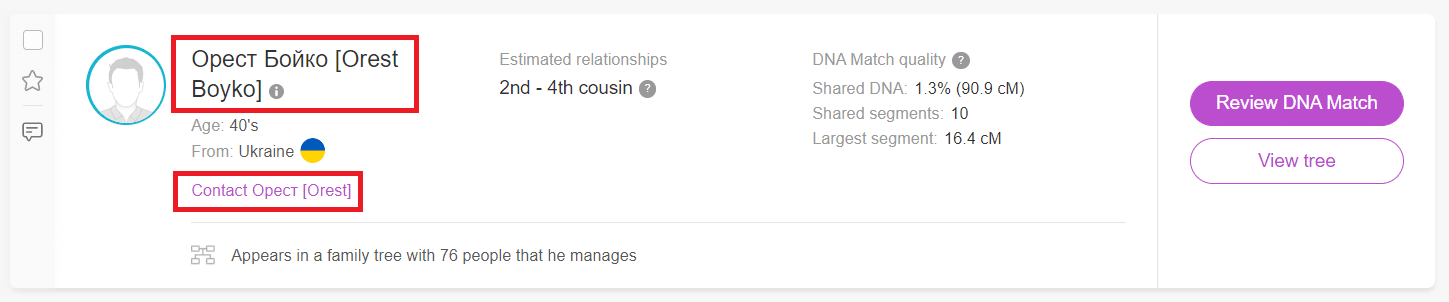
As you scroll through your DNA Matches, you’ll notice that for names of matches written in non-Latin letters, a set of square brackets with the transliterated name now appears directly after the original name. In the example below, the name of the match is originally written in Ukrainian, and an English transliteration appears in the brackets that follow. Further down the card, the link to contact this match also shows the transliterated name, making it easier for users to contact DNA Matches whose names they would not otherwise have known due the language barrier.
Example of a Ukrainian name transliterated to English (click to zoom)
For users whose MyHeritage site language is set to Hebrew or Greek, DNA Match names that are in English will likewise appear in brackets in the user’s language. In the example below, Jacob Glick’s name appears in English, with the Hebrew transliteration directly next to it.
Example of an English name transliterated to Hebrew (click to zoom)
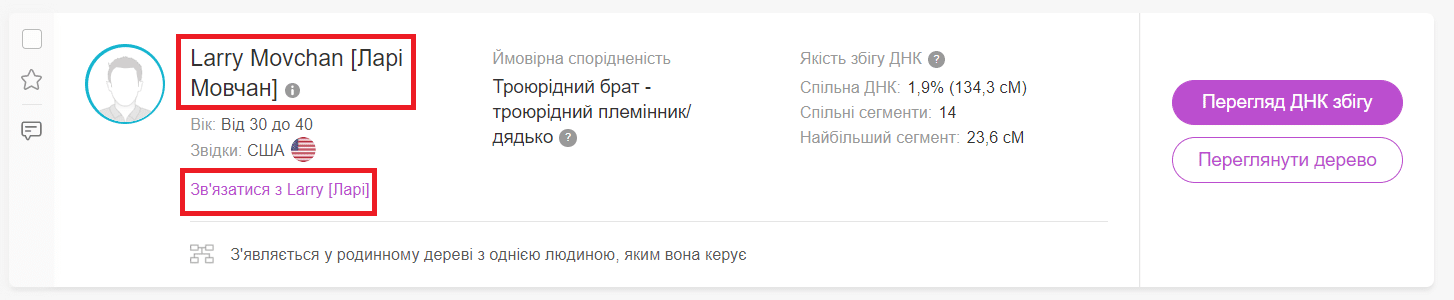
The same is true for users who work with MyHeritage in Russian or Ukrainian and receive DNA Matches to individuals with names that use the Latin alphabet. In the example below, the MyHeritage site language is Ukrainian, and the name of the DNA Match, Larry Movchan, appears in English with the Ukrainian transliteration displayed in brackets.
Example of an English name transliterated to Ukrainian (click to zoom)
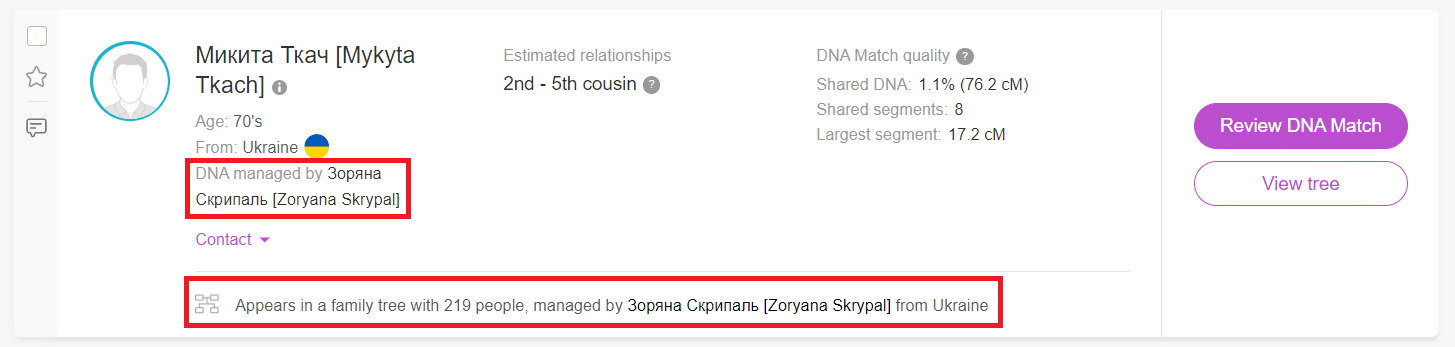
For users whose DNA kit is managed by someone other than themselves, the transliteration of the kit manager’s name will appear in brackets alongside the names in their language. If the match in question appears in a family tree that is managed by another MyHeritage user, the tree manager’s name is also transliterated.
Transliterations appear for names of DNA kit managers (click to zoom)
When clicking on the “Contact” drop down below the name of the DNA kit manager, the names of both the DNA Match and the kit manager also include transliterations.
Transliteration of DNA Match and kit manager’s names
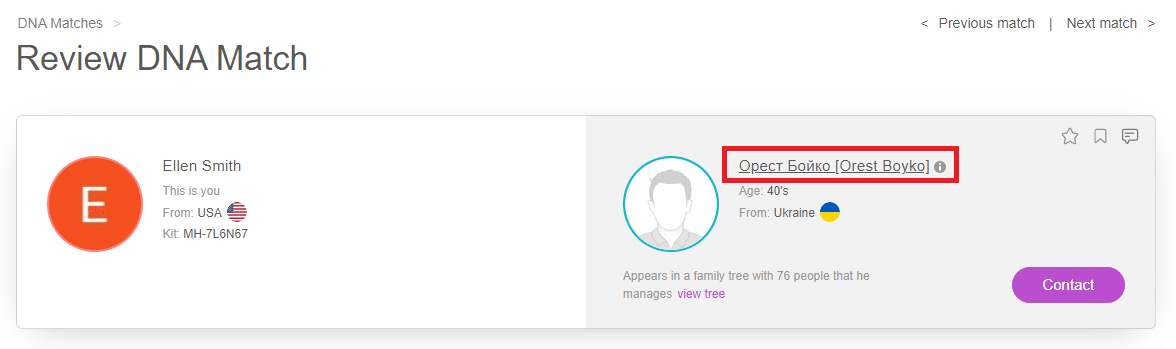
Transliterated names are also displayed on the Review DNA Match page.
Name transliteration on the Review DNA Match page
This functionality is currently not available when reviewing Shared DNA Matches, and we plan to add it in the near future. It’s also important to note that DNA Matches who have set their names to private will not have their names transliterated.
Our DNA Matching algorithms automatically calculate new matches for you, and MyHeritage DNA users receive weekly emails notifying them when we’ve found new DNA Matches. Transliterated names are now displayed in those emails, making it easier to understand the match at a glance and see if perhaps you share a common surname, or if something about their name sparks your curiosity.
Global Name Translation™ is a powerful technology that has opened new frontiers for MyHeritage users researching their family history around the world. This technology is unique to MyHeritage, and we hope this new extension of it will facilitate more communication among DNA Matches. Anyone who has DNA results on MyHeritage can now view the transliterated names of their DNA Matches.
Language is one obstacle that shouldn’t hinder family history research. We are proud to continue our tradition of innovation as our technologies help overcome language barriers and foster a more seamless path to discovery.


 |
| Genetic Affairs Logo |
 |
| Portion of a sample Cluster report from Genetic Affairs. (Click to enlarge image.) |
 |
| The Shared Ancestral Places screen at MyHeritage. |
I'm happy to announce another industry first from MyHeritage! We now support the upload of 23andMe v5 and Living DNA data files, in addition to supporting data uploads from all major DNA testing services, including Ancestry, 23andMe (prior to V5) and Family Tree DNA (Family Finder).
Since 2016, MyHeritage has allowed users who have already tested their DNA to upload their DNA data from Ancestry, 23andMe and Family Tree DNA. They receive DNA Matches and ethnicity estimates on MyHeritage for free. However, previously MyHeritage did not support the upload of tests based on the chip called GSA (Global Screening Array), now being used by 23andMe (v5), and by Living DNA. Recent improvements to our DNA algorithms now allow us to support DNA data processed on GSA chips, and so we now support uploads of 23andMe v5 and Living DNA data files.Uploading DNA data to MyHeritage is fast and simple. For users that upload now, we offer full access to DNA Matching, Ethnicity Estimates, our industry-leading chromosome browser, and more, for FREE.
You can read their full blog post here.Upcoming changesAs of December 1, 2018, our policy regarding DNA uploads will change: DNA Matching will remain free for uploaded DNA data, but unlocking additional DNA features (for example, ethnicity estimate, chromosome browser, and some others) will require an extra payment for DNA files uploaded after this date. We will announce the full details of the new policy once it is finalized, closer to December 1st. All DNA data that was uploaded to MyHeritage in the past, and all DNA data that is uploaded now and prior to December 1, 2018, will continue to enjoy full access to all DNA features for free. These uploads will be grandfathered in and will remain free.

Today, we announce that Ancestry will deliver ethnicity estimates with increased precision to its customers, through a new algorithm that analyzes longer segments of genetic information, marking an important evolution in the way we interpret DNA data. Having built and expanded our DNA reference panel, we have a better understanding of genetic signatures globally, can break down geographic ethnicity estimates with greater specificity and give you a more detailed picture of your origins.
The rollout of our enhanced ethnicity estimates will take place on September 12, 2018 and with this update, new and existing customers can expect more precise results across Asia and Europe. For example, Scandinavia will be more clearly defined as Norway and Sweden and Asia East will be broken down into six regions (Japan, Korea and Northern China, China, Southeast Asia—Dai (Tai), Southeast Asia—Vietnam, Philippines). All updates to existing customers will be free of charge.
But we never stand still. Genomics is an emerging field and as a leader in this field, we remain committed to investing in ‘what’s next’. This next generation ethnicity estimate is one more way Ancestry is helping people discover, with greater detail, the stories of those who came before them.You can read their full blog post here.